
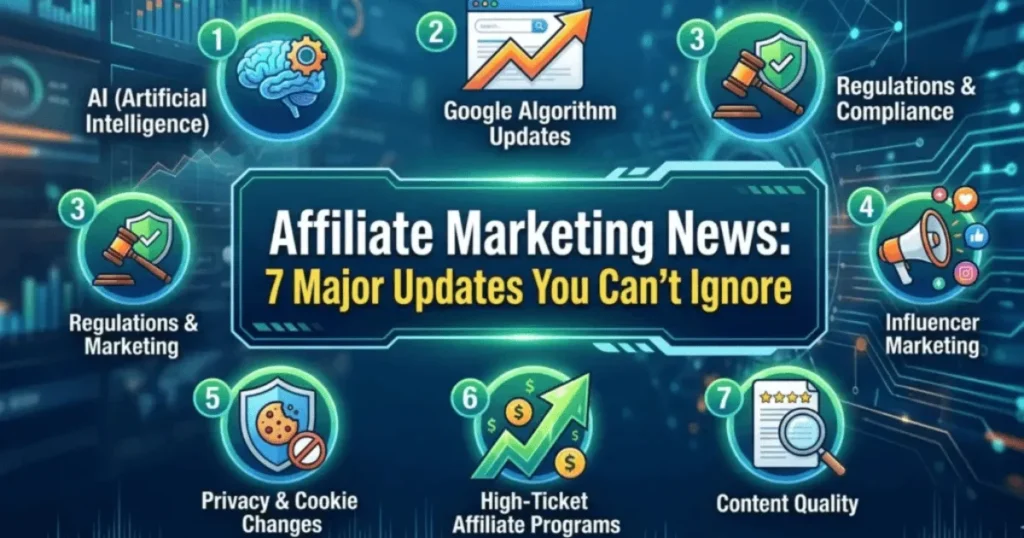
Affiliate Marketing News 7 Major Updates You Can’t Ignore
- By Admin
- April 13, 2026
- 9:58 am
Let’s be honest – affiliate marketing has never been more competitive.
In 2025 and heading into 2026, the rules of the game are changing at a pace that can feel overwhelming. New Google algorithm updates, AI-powered tools, shifting consumer privacy expectations, and tighter regulations are all reshaping how affiliate marketers earn their income.
If you are not keeping up with the latest affiliate marketing news, you could easily fall behind – losing rankings, traffic, and revenue to competitors who are more informed and more agile.
The good news? You do not need to read 50 newsletters a week to stay ahead. In this guide, we have compiled the most important affiliate marketing updates for 2025 and 2026, explained clearly and with practical takeaways you can actually use.
Whether you are just starting out or you have been in space for years, this article will help you understand where the industry is heading – and what you should do about it today.
1. AI Is No Longer Optional in Affiliate Marketing
If there is one theme dominating affiliate marketing industry news right now, it is artificial intelligence. A year ago, AI tools were a “nice to have.” Today, they are practically essential.
How AI Is Changing the Game
AI is not just about writing blog posts faster (though it does help with that). The real power lies in what AI can do behind the scenes:
- Content ideation and optimization – AI tools analyze top-ranking pages and help you create content that is structured to rank.
- Predictive product selection – Advanced tools now use data signals to identify which products are likely to convert before you invest hours promoting them.
- Personalized user experiences – Platforms can now serve different product recommendations to different visitors based on behavior, dramatically increasing conversions.
- Automated A/B testing – AI tools can run split tests continuously without manual setup.
According to industry data, AI-driven personalization can increase conversion rates by up to 20 percent, depending on the niche and implementation.
What This Means for You
If you are still creating content purely by instinct and publishing without any data-backed optimization, you are competing with one hand behind your back. Tools like Surfer SEO, Clearscope, and even Claude or ChatGPT (when used strategically) can give you a meaningful edge.
The key is to use AI as a research and optimization assistant – not a replacement for real expertise, authentic voice, or genuine product knowledge.
2. Google Algorithm Updates Are Shaking Up Affiliate Rankings
This is one of the most talked-about topics in affiliate marketing news circles right now – and for good reason. Google’s recent core algorithm updates have been particularly aggressive toward affiliate websites.
What Google Is Rewarding (and What It Is Penalizing)
The pattern is clear. Google is pushing thin, generic affiliate content down the rankings and elevating content that demonstrates:
- First-hand experience with the product or service being reviewed
- Original research or data that adds value beyond what is already indexed
- Expert-level authority in the niche, demonstrated through depth and accuracy
- Helpful, user-first intent rather than content written primarily to earn a commission
Generic “Top 10 Products” roundups that rehash Amazon reviews without any real insight are declining in visibility. Meanwhile, in-depth, experience-driven reviews are climbing.
Practical Strategy Shifts
If your affiliate site was hit by a recent update, or if you simply want to future-proof your content, here is what to focus on:
- Rewrite thin content with genuine insights, personal observations, and real comparisons
- Add structured data (schema markup) to your reviews for better SERP visibility
- Fix any technical issues holding your site back – you can learn more about avoiding common SEO Mistakes that quietly drain your rankings
Build topical authority by covering your niche comprehensively, not just cherry-picking high-volume keywords
3. Stricter Regulations Are Coming - And Compliance Is Non-Negotiable
One of the most underreported areas of affiliate marketing updates in 2025 involves regulatory changes. Governments and platforms are tightening their standards, and the days of quietly burying a disclosure link at the bottom of a post are officially over.
What Has Changed
- The FTC (Federal Trade Commission) in the United States has sharpened its enforcement of affiliate disclosure rules. Every post, video, or social media update that earns you a commission must clearly state that relationship – visibly, and near the top of the content.
- The EU’s Digital Services Act is influencing how platforms handle sponsored content across Europe, with knock-on effects for global affiliate marketers.
- Social media platforms like Instagram, TikTok, and YouTube have introduced stricter in-platform disclosure requirements for creators, with automated detection for undisclosed partnerships.
How to Stay Compliant
- Use clear, plain-language disclosures such as “This post contains affiliate links. I may earn a commission if you make a purchase.”
- Place disclosures above the fold – before the reader needs to scroll
- Apply disclosures to every content format: blog posts, emails, video descriptions, and social posts
- Review platform-specific guidelines regularly, as they change frequently
Compliance is not just a legal issue – it is a trust issue. Readers who feel misled do not come back.
4. Influencer Marketing Is Becoming a Core Affiliate Channel
One of the biggest shifts in recent affiliate marketing industry news is how seriously brands and affiliate networks are investing in influencer partnerships. What was once a separate marketing channel is now deeply intertwined with affiliate marketing.
Why Influencer-Affiliate Marketing Works
The combination is powerful because it merges the trust of a personal recommendation with the performance-based accountability of affiliate tracking. Here is why it converts so well:
- Audiences trust people, not ads. A recommendation from a creator someone follows feels authentic.
- Short-form video drives purchase intent. TikTok and Instagram Reels create impulse buying moments that blog posts rarely replicate.
- Micro-influencers often outperform mega-influencers. A creator with 15,000 engaged followers in a specific niche frequently delivers higher ROI than a celebrity with a million passive followers.
How to Apply This to Your Strategy
Even if you are not an influencer yourself, this trend creates opportunity:
- Recruit micro-influencers as sub-affiliates in your niche – this is increasingly common and easy to set up through most affiliate networks
- Create video content on YouTube or TikTok to diversify away from pure SEO traffic
- Partner with niche creators for product review collaborations that generate both referral traffic and backlinks
5. Third-Party Tracking Is Dying - Here Is What Replaces It
If you have been following affiliate marketing news over the past couple of years, you already know that third-party cookies are on the way out. But many affiliates still have not adapted their strategy to reflect this reality.
What Is Changing
Major browsers, led by Safari and Firefox (and eventually Chrome), are blocking or limiting third-party tracking cookies. This means:
- Attribution for affiliate clicks is becoming less reliable through traditional methods
- Retargeting and cross-site tracking are degraded
- Affiliate networks are being forced to evolve their tracking infrastructure
What to Do Instead
The answer lies in first-party data – information you collect directly from your audience with their consent. This includes:
- Email lists: An engaged email subscriber is worth far more than a search visitor who lands, bounces, and disappears. Prioritize list building.
- On-site user accounts or community tools: These create direct relationships and data touchpoints.
- First-party analytics: Tools like privacy-first analytics platforms give you accurate data without relying on third-party cookies.
The affiliates building loyal audiences today are the ones who will be insulated from tracking disruptions tomorrow.
6. High-Ticket Affiliate Programs Are Delivering Bigger Returns
One of the most actionable pieces of affiliate marketing news you can act on immediately is the shift toward high-ticket and high-commission programs.
Why the Math Favors High-Ticket
Consider the difference:
Scenario | Product Price | Commission Rate | Earnings Per Sale |
Low-ticket | $20 | 10% | $2.00 |
High-ticket | $500 | 20% | $100.00 |
To earn $1,000 in commissions at the low-ticket level, you need 500 sales. At the high-ticket level, you only need 10.
Popular High-Ticket Affiliate Categories in 2025–2026
- SaaS products and software tools – recurring commissions make these especially lucrative
- Online education and certification programs – course platforms often offer 30–50% commissions
- Financial products – credit cards, investment platforms, and insurance products
- B2B services – marketing tools, CRMs, and productivity software often have generous partner programs
- Premium health and wellness – high-end supplements, fitness equipment, and biohacking products
If you are currently promoting low-margin products, it is worth auditing your affiliate portfolio and identifying where you could swap in higher-value alternatives.
7. Content Quality Is the Ultimate Differentiator Right Now
Here is the uncomfortable truth buried inside all the latest affiliate marketing updates: with AI making it easier than ever to produce mediocre content at scale, the bar for what “good content” looks like has actually risen – not fallen.
Google has become remarkably good at distinguishing genuinely helpful, experience-driven content from AI-generated fluff. And so have readers.
What High-Quality Affiliate Content Looks Like in 2026
- It answers questions no one else is answering. Not just “what is the best VPN” – but “what is the best VPN for someone who travels to China frequently and needs to unblock specific streaming services.”
- It includes real data, real screenshots, or real test results. Generic claims without evidence are losing ground fast.
- It is written for a specific reader, not for a generic keyword. The more clearly you picture your reader, the more compelling your content becomes.
- It updates regularly. Stale content signals neglect to both Google and readers.
For a site like RankSoftTech, this is a genuine competitive advantage. Publishing authoritative, data-driven content across affiliate marketing and digital strategy topics builds long-term topical authority that compounds over time.
Choosing the Right Partnerships and Platforms
Staying on top of affiliate marketing industry news also means knowing how to evaluate the partners you work with – whether those are affiliate networks, digital marketing agencies, or software platforms.
As the industry grows more sophisticated, the quality gap between good and bad affiliate programs is widening. Some platforms offer real-time tracking, transparent reporting, and reliable payouts. Others do not.
If you are building a serious affiliate business or evaluating a digital marketing partner to help you grow, it pays to do your homework. Our guide on how to choose digital marketing agency walks through the key questions you should ask before committing to any partnership.
The same due diligence applies to affiliate networks: look for transparent cookie windows, accurate attribution, and a history of on-time payments.
Conclusion
The affiliate marketing landscape in 2025–2026 is both more challenging and more rewarding than it has ever been. The barriers to entry have dropped, but so has the tolerance for low-quality, low-effort approaches.
Here is what the most important affiliate marketing news this year is telling us:
- Adopt AI tools to speed up research, optimize content, and identify high-converting opportunities – but do not let AI replace your authentic voice.
- Prioritize content quality over content quantity. One genuinely helpful, well-researched article outperforms ten thin pages.
- Build first-party data assets – your email list is your most valuable affiliate asset in a post-cookie world.
- Explore high-ticket programs to increase your revenue per conversion, not just your conversion volume.
- Stay compliant – the cost of ignoring disclosure requirements far outweighs the inconvenience of adding a few lines of text.
- Diversify your traffic beyond SEO by testing influencer partnerships and short-form video.
The affiliates winning in this environment are not necessarily the biggest or the best-funded. They are the ones who stay informed, adapt quickly, and consistently put their audience first.
FAQ's
What is the biggest affiliate marketing trend in 2025–2026?
AI-driven content optimization and personalization are the most transformative trends right now. Affiliates using AI for research, content structuring, and conversion optimization are seeing meaningful improvements in both traffic and revenue. That said, content quality and first-party data building are just as important – AI is a tool, not a strategy on its own.
Is affiliate marketing still a profitable income stream in 2026?
Absolutely – but profitability increasingly depends on your approach. Thin, generic content and heavy reliance on third-party tracking are becoming less viable. Affiliates who focus on niche authority, genuine product expertise, and audience ownership through email lists are growing their income substantially.
How important are affiliate marketing regulations today?
More important than ever. The FTC and international equivalents are actively enforcing disclosure requirements. Beyond the legal risk, clear and honest disclosures build audience trust – which directly impacts long-term conversion rates. Compliance is good business, not just good ethics.
What is first-party data and why does it matter for affiliate marketers?
First-party data is information you collect directly from your audience – primarily through email sign-ups, on-site accounts, or direct interactions. As third-party tracking cookies are phased out, affiliates who own direct relationships with their audience have a lasting advantage over those who depend entirely on search or social traffic.
How can beginners get started with high-ticket affiliate marketing?
Start by identifying your niche, then research affiliate programs in that space that offer higher commission values – SaaS tools, online courses, and financial products are good starting points. Build trust with your audience through consistent, honest content before promoting high-ticket items. Your conversion rate on expensive products depends almost entirely on how much your audience trusts your recommendations.

Stay Updated with Digital Marketing Trends & SEO Insights
Get the latest SEO updates, digital marketing tips, Google algorithm changes, and growth strategies delivered directly to your inbox.