
5 Technical SEO Mistakes Killing Your Organic Traffic
- By Admin
- May 19, 2026
- 1:48 pm
Organic search traffic rarely evaporates without a reason. When rankings stagnate or plummet, website owners usually rush to publish more content. They assume that increasing volume will automatically solve the problem.
However, in today’s search environment—driven by AI overviews and complex semantic parsing—this “more is better” approach often accelerates the decline.
The reality is that your traffic drop is likely rooted in systemic, structural SEO mistakes. Standard advice like “compress your images” or “write for humans” is no longer enough to move the needle. To recover and dominate your niche, you need an enterprise-grade diagnostic framework.
At RankSoftTech, our technical audits reveal that the vast majority of visibility failures stem from overlooked technical bottlenecks and semantic misalignments. This blueprint dissects the top five algorithmic mistakes and provides the exact triage protocols you need to restore your visibility.
Quick Summary: The Root Causes of Traffic Drops
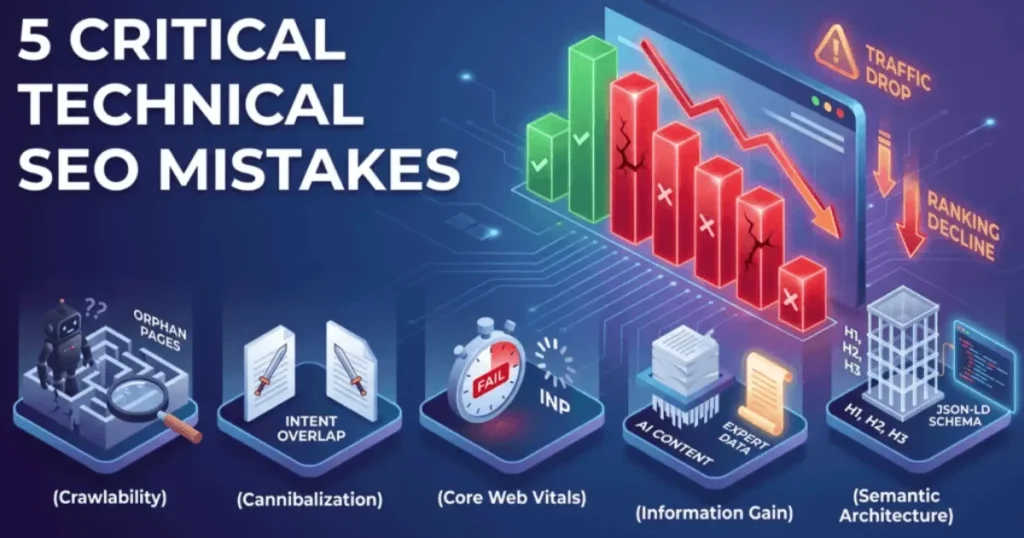
- Crawlability Bottlenecks: High crawl depth and orphaned pages block indexing.
- Keyword Cannibalization: Multiple pages competing for the exact same search intent.
- Core Web Vitals Deterioration: Failing modern latency metrics like Interaction to Next Paint (INP).
- Information Gain Deficits: Publishing generic content that lacks unique expert insights.
- Semantic Architecture Omissions: Missing entity connections and advanced JSON-LD schema markup.
1. Crawlability & Indexing Bottlenecks (Why Google Ignores Your Pages)
One of the most insidious SEO mistakes is assuming that hitting “publish” guarantees indexing. If your website architecture resembles a complex maze rather than a clear hierarchy, Googlebot will exhaust its crawl budget before it ever reaches your most valuable assets.
The Symptom: High Crawl Depth & Orphaned Pages
Crawl depth is simply the number of clicks required to reach a page from your homepage. If a page sits beyond a depth of three clicks, you are signaling to search engines that it holds low value.
Furthermore, “orphaned pages”—URLs with zero internal links pointing to them—are virtually invisible to both users and web crawlers.
The Fix: Engineering a High-Efficiency Link Hierarchy
You cannot fix what you cannot see. Standard tools often scratch the surface, so you need to dig deeper:
- Run a Log File Analysis: Use a tool like Screaming Frog connected to your Google Search Console API to see exactly which URLs Googlebot is hitting and ignoring.
- Audit Your XML Sitemap: Ensure you are only submitting clean, 200 OK status code URLs.
- Build Entity-Based Clusters: Parent pillar pages should link down to supporting subtopics, and those subtopics should link back up using asymmetrical anchor text. This strategic routing tells search engines exactly how your topics relate.
2. The Semantic Crisis: Keyword Cannibalization vs. Duplicate Content
Many website owners confuse duplicate content (copy-pasting the exact same text) with keyword cannibalization. Modern search algorithms easily filter out duplicate content, but keyword cannibalization is a severe mistake that actively destroys your rankings.
Why Intent Overlap Kills Rankings
Cannibalization happens when multiple pages on your site satisfy the exact same semantic search intent. For example, having one page targeting “best running shoes” and another targeting “top running sneakers.”
Google’s core ranking systems view this as topic dilution. Instead of awarding top placement to one authoritative page, it splits your domain’s authority between two weaker competitors.
The Remedial Protocol: Content Consolidation
To diagnose and fix this semantic overlap, follow this triage protocol:
- Open Google Search Console: Navigate to the Performance report and filter by your target query.
- Check the Pages Tab: If multiple URLs are generating impressions for the exact same query, you have an intent overlap issue.
- Consolidate Your Assets: Identify the strongest page. Merge the unique, valuable content from the weaker pages into this primary asset.
- Implement 301 Redirects: Redirect the weaker URLs to the newly consolidated powerhouse page to preserve all existing link equity.
3. Core Web Vitals: Moving Beyond Basic Image Compression
When auditing technical SEO, advice usually stops at “make your site faster by compressing images.” Moving into 2025, relying on this basic tip is a massive underestimation of how Google measures user experience.
The Missing Metric: Interaction to Next Paint (INP)
Google officially replaced First Input Delay (FID) with Interaction to Next Paint (INP). This vital metric measures the latency of all click, tap, and keyboard interactions throughout a user’s entire lifespan on a page.
Consider a high-stakes eCommerce environment. If a user is filtering specifications for an HP 15-fd0133wm laptop and clicks a dropdown menu, a bloated Document Object Model (DOM) size might cause the page to freeze for 300 milliseconds. That tiny delay causes your INP score to fail, dragging your rankings down with it.
The Fix: Real Latency Mitigation
High INP and poor Largest Contentful Paint (LCP) scores are rarely caused by images alone. They are caused by heavy, unused JavaScript execution blocking the main thread.
- Audit Third-Party Scripts: Defer or asynchronously load non-critical tracking scripts and widgets.
- Reduce DOM Complexity: Avoid nested page builders that create hundreds of unnecessary <div> tags.
- Preconnect and Preload: Use resource hints to prioritize the loading of critical, above-the-fold assets.
4. Contextual Mismatch & the Need for Information Gain
Ranking at the top of Google requires satisfying the user’s ultimate goal. Misunderstanding search intent—whether it is informational, commercial, transactional, or navigational—is a fatal error.
Decoding the Intent Vector
If a user searches for “how to fix a leaky faucet,” they want a step-by-step tutorial (Informational), not a product page for wrenches (Transactional). Even heavily monetized sites in the Affiliate Marketing space must balance commercial conversion goals with deep, informational value to satisfy intent algorithms.
The E-E-A-T and Information Gain Imperative
With the rise of AI Overviews, pumping out generic, AI-generated content is a fast track to algorithmic penalization. Search engines now measure your Information Gain Score—the amount of unique, net-new information your page provides that the top competitors lack.
As Qamar Mahtab, CEO of DenebrixAI, frequently notes, modern algorithms are entity-processing machines. They look for unique, verifiable insights rather than repackaged text. To inject high E-E-A-T (Experience, Expertise, Authoritativeness, Trustworthiness) into your content:
- Use proprietary data or internal company statistics.
- Include quotes from verified subject matter experts.
- Detail hands-on, real-world experiences with the subject matter.
5. Semantic Architecture: Schema Markup and Document Structure
Search engines do not “read” your website like humans do. They parse it by extracting entities and structural cues. Failing to frame your document properly is a massive missed opportunity.
Proper Structural Parsing for AI Search Engines
Your heading tags (H1, H2, H3) are not design elements meant to make text larger; they are the semantic skeleton of your document.
- H1: The core topic (only one per page).
- H2: Primary subtopics that directly support the H1.
- H3: Granular details supporting the H2.
Skipping heading levels (like jumping from an H1 to an H3) breaks your structural logic, confusing AI parsers trying to determine your hierarchy.
The Power of Advanced JSON-LD Structured Data
Relying solely on on-page text is no longer sufficient. To guarantee Google understands the entities on your page, you must deploy JSON-LD Schema Markup.
Beyond basic “Article” schema, utilize FAQPage, TechArticle, Organization, and Person schemas to explicitly connect your brand to your industry’s Knowledge Graph.
Implementing these advanced protocols ensures your website is easily understood by search algorithms. If these technical optimizations feel overwhelming, figuring out How to Choose Digital Marketing Agency partners with deep technical SEO expertise is the logical next step to turn raw traffic into real growth.
FAQs
What are the most common SEO mistakes hurting my traffic?
The most impactful mistakes include keyword cannibalization, failing Core Web Vitals (specifically INP), neglecting search intent alignment, poor internal linking, and publishing generic content that lacks a high Information Gain score.
How do I actually fix keyword cannibalization?
First, identify competing pages using Google Search Console’s performance data. Consolidate those competing URLs by merging the best content into one primary, authoritative page. Finally, implement a 301 redirect from the old, secondary URLs to the new primary page to preserve your link equity.
Why is my website traffic dropping despite publishing regularly?
Publishing high volumes of content without unique insights leads to topic dilution. If your new content lacks E-E-A-T signals or duplicates existing semantic intent on your site, search algorithms will actively suppress your domain’s overall visibility.
What is the difference between duplicate content and intent overlap?
Duplicate content means the exact same text appears on multiple pages. Intent overlap (keyword cannibalization) means multiple pages are trying to answer the exact same user question, even if the text itself is completely unique. Both harm SEO, but intent overlap is far more common on established websites.
Stay Updated with Digital Marketing Trends & SEO Insights
Get the latest SEO updates, digital marketing tips, Google algorithm changes, and growth strategies delivered directly to your inbox.