
Local SEO Strategies: 15 Proven Tactics for 2026
- By Admin
- July 8, 2026
- 11:49 am
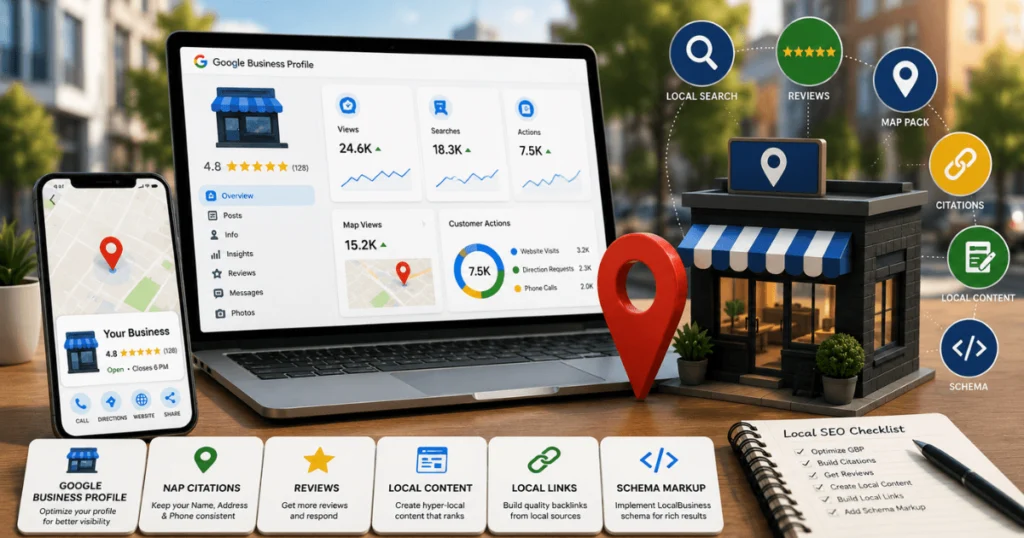
Local SEO strategies help businesses become more visible when people search for products or services in a specific area. A strong local SEO strategy combines Google Business Profile optimization, accurate business information, relevant local content, customer reviews, citations, local links, and technical improvements.
In this guide, you’ll learn practical local SEO strategies and tactics you can use to improve local search visibility, strengthen your local presence, and attract more relevant customers in 2026.
Key Takeaways
- Google Business Profile (GBP) helps Google understand your business and can improve your visibility in relevant local searches when the profile is complete and accurate.
- Consistent NAP details (name, address, phone number) across every directory eliminates trust signal fragmentation that tanks local rankings.
- Reviews are both a trust and conversion asset, while Google says review quantity and positive ratings can contribute to local prominence.
- Hyper-local content (district service pages, neighborhood guides, landmark-referenced posts) builds topical authority that generic city-keyword pages can’t touch.
- LocalBusiness structured data can help Google understand important business details such as location, hours, and other business information.
- Voice and AI search are reshaping query patterns, optimizing for conversational long-tail phrases now captures traffic most businesses aren’t even tracking yet.
How Google Determines Local Rankings
Most guides say the local algorithm weighs “relevance, proximity, and prominence.” True, but in 2026, that framing is too thin to act on.
Here’s what the local algorithm is actually doing under the hood. It’s running a context-driven evaluation, not just keyword matching. When someone searches “dentist open Saturday near Oakwood,” Google isn’t just looking for who has the word “dentist” on their website. It’s cross-referencing your Google Business Profile category, the recency and sentiment of your Google reviews, whether your GBP has Saturday hours listed, proximity signals from the searcher’s device location, and behavioral signals, how often people who saw your local listing actually clicked, called, or asked for directions.
The AI layer matters now too. Google’s AI Overviews pull from local search results for service queries. I’ve watched a well-structured GBP with consistent citations and a single well-written service page outrank sites with ten times the domain authority, because the AI could extract a clean, verifiable answer from it. For AI-powered search experiences, clear and self-contained answers can make content easier for search systems to understand and use.
One thing most competitors get wrong: they treat local SEO as a one-time setup. It’s not. Google’s local ranking factors are increasingly behavioral, direction requests, phone calls, booking submissions from your listing. These ongoing signals mean your local rank changes based on how customers actually interact with you, not just how you configured your profile two years ago.
Getting Your Google Business Profile Right
Google Business Profile listings often have avoidable issues, such as an inaccurate primary category, missing secondary categories, outdated or low-quality photos, and incomplete Q&A sections. Addressing these areas can help businesses provide Google and potential customers with clearer, more complete information about their services and location.
Category selection matters more than many businesses realize. Your primary category helps Google understand what your business offers and can influence which local searches your Business Profile is considered relevant for. Choose the most accurate primary category available for your business rather than selecting a category simply because it contains a preferred keyword.
Review Google’s available category suggestions and consider relevant secondary categories that accurately describe your main services. For example, a business offering SEO, WordPress development, and app store optimization should select categories that genuinely reflect those services where available.
Complete relevant business attributes. Depending on your business type and location, Google Business Profile may provide attributes that help customers understand important details about your business. Complete the attributes that genuinely apply to your business, such as online appointments, accessibility, payment options, or available services.
Accurate and complete information makes it easier for potential customers to understand what your business offers before they visit your website, contact you, or choose your business from local search results.
Keep your photos and Google Business Profile content up to date. Use original, relevant images that accurately represent your business, team, services, products, or location. Avoid relying entirely on generic stock photography, and replace outdated images when they no longer represent your business accurately.
You can also use Google Business Profile posts to share relevant updates, services, offers, events, or useful information. The goal should be to keep your profile informative and useful for potential customers rather than publishing content simply to influence rankings.
Use the Q&A section to answer common customer questions. Google Business Profile allows businesses to provide useful information through the Q&A section. Consider adding questions that potential customers commonly ask, such as “What areas do you serve?”, “Do you offer online appointments?”, or “What services do you provide?” where this feature is available.
Keep the answers clear, accurate, and genuinely helpful. Include relevant service or location information naturally when it helps answer the question, but avoid keyword stuffing. Regularly review the section and respond to legitimate customer questions to keep the information accurate.
NAP Citations: The Foundation That Kills Rankings When It's Wrong
NAP citation consistency, your name, address, and phone number appearing identically across every directory and social media profile, sounds boring. It took me three months of ranking plateau on a client account before I found the issue: their address was listed two different ways across major data aggregators, causing what I now call data fragmentation.
Search engines verify business legitimacy by cross-referencing your GBP data against mentions across the web. When the address on your website footer says “Suite 200” but Yelp says “Ste. 200” and Yellow Pages has no suite number at all, those are three different signals, and Google treats inconsistency as a trust deficit.
The fix:
- Start with the big data aggregators, in the U.S., that means Data Axle, Localeze, and Foursquare. These feed hundreds of downstream directories. Fix the source and the corrections propagate.
- Manually verify your listing on Apple Maps, Yelp, Yellow Pages, Bing Places, and Facebook. These are high-authority platforms that directly influence local ranking factors.
- Run a citation audit, BrightLocal’s tool or Whitespark work well, to surface every inconsistent mention.
- Standardize your NAPW format (adding website URL) and use that exact format everywhere, including your own homepage.
Citation authority still matters for local ranking in 2026, but volume has become less important than consistency and the authority of the directories themselves. Ten consistent listings on high-DA local directories beat fifty inconsistent ones every time.
Reviews: How to Turn Them Into a Ranking and Conversion Engine
Here’s the thing most people miss about reviews: they’re not just a ranking signal, they’re a conversion asset that shows up directly in your Google SERP feature, the star ratings, review count, and even review snippets that appear before someone clicks your listing.
A business with 4.7/5 from 200 reviews doesn’t just rank better, it converts clicks at a fundamentally different rate than a business with 3.9 from 12 reviews, even if they’re in the same local pack position.
My review generation process that actually works:
- SMS reminders sent 24–48 hours after service completion outperform email by roughly 3:1 in response rate. Keep the message short: “Thanks for choosing us, would you mind sharing your experience? [link]”
- Follow-up emails work for B2B or higher-ticket services where the relationship is more considered.
- Never offer incentives. It’s against Google’s terms and creates a pattern of fake-feeling reviews that sophisticated users spot instantly.
- Respond to every review, including negative ones. How you respond to a 2-star review tells prospective customers more about your business than ten 5-star reviews. A professional, solution-focused response to a complaint is social proof in itself.
For businesses with multiple locations, tools like InMoment’s local listings management software can centralize review monitoring across platforms including Google, Yelp, and industry-specific review platforms. The centralized platform view makes it possible to catch a reputation problem at one location before it compounds.
Review signals for the local pack: Quantity, recency, aggregate rating values, and the presence of owner responses all feed Google’s local ranking factors. A consistent flow of 3–5 new reviews per month beats 50 reviews in January and zero for the rest of the year.
Hyper-Local Content: What "Local" Content Actually Means in 2026
“Just add your city name to your pages” is the most outdated local SEO advice still circulating. Google’s understanding of local context has gotten far more sophisticated, it recognizes semantic entities like neighborhoods, landmarks, schools, transit routes, and shopping centers as geographic signals, not just city keywords.
Here’s what actually builds local authority through content:
District service pages target neighborhoods or suburbs individually. A plumber serving Chicago shouldn’t have one service page, they should have separate pages for Lincoln Park, Wicker Park, Logan Square, and Evanston. Each page references the zip codes, landmarks, and local context (e.g., “we’ve handled burst pipe repairs in Wicker Park’s older greystone buildings, where the original plumbing from the 1920s still runs”) that makes the page genuinely useful and locally relevant.
Blog entries targeting neighborhood events, local attractions, and hidden gems aren’t just fluff, they build topical authority around your geographic region and attract inbound links from local community sites and local news citations. A post about sponsoring a neighborhood block party gets shared by attendees, earns a link from the community newsletter, and signals to Google that you’re genuinely embedded in that area.
Internal linking between your service pages and location content reinforces your topical authority map. Link from “plumber in Lincoln Park” to “burst pipe repair” to “emergency plumbing Chicago”, this creates a semantic web that helps search engines understand your full service offering across your geographic region.
I’ve seen single-location businesses that dominated their local market purely through this kind of hyper-local content marketing, consistently ranking above franchises with 100x the brand authority. Geographic relevance built from real community connection beats broad brand signals for local pack placements every time.
Local Link Building: The Tactic Most Local Businesses Ignore Entirely
31% of SEOs rate backlinks as the most important ranking signal for regular organic results, per BrightLocal’s research, and for regular organic results (whether for local businesses or sites tracking affiliate marketing news), they’re the biggest lever
Local link building is different from standard link building. You’re not chasing DA-90 editorial links, you’re building a backlink profile that signals local relevance and community trust. The tactics that work:
Supplier and co-partner links. If you use local suppliers, ask for a mention on their website. If you refer customers to complementary businesses, set up a mutual linking arrangement. These are easy, relevant, and often overlooked.
Guest blogging on local community blogs and local news sites. A post on your city’s neighborhood blog about your area of expertise, not a promotional piece, but genuinely useful content, earns an authoritative local link and puts you in front of a hyper-local audience.
Sponsoring local events, local charities, and community initiatives. Event sponsorship links from community organizations, local charities, and schools are among the cleanest local links you can build. They’re editorially earned, geographically relevant, and come with genuine brand visibility.
Press releases for genuinely newsworthy business developments, new location openings, significant hires, community awards, distributed to local news outlets can earn natural local citations that build citation authority at the media level.
Linkable assets like in-depth local guides, infographics about your service area, and local resource directories on your own site attract inbound links passively. A “Complete Guide to [Your City’s] Building Permit Process” written by a local contractor is legitimately useful, gets cited by other local contractors, and builds domain authority.
For finding gaps in your local backlink profile, Ahrefs’ Link Intersect tool is the fastest method, paste in 3–5 competing local businesses and it surfaces every domain linking to them that doesn’t link to you. Most of those will be local directories, community sites, and industry associations where a listing is either free or easy to acquire.
Local Business Schema: The Technical Win 80% of Local Sites Still Haven't Done
This is the section most local SEO guides skip because it feels technical. Don’t skip it, structured data is one of the highest-ROI optimizations in local SEO right now, and it’s entirely within a business owner’s control.
Local Business schema is a structured data markup (in JSON-LD format) that tells Google’s Knowledge Graph exactly what your business is, where it is, when it’s open, and what it offers. When correctly implemented, it can trigger rich results including star ratings, Knowledge Panel features, and the business properties Google displays directly in SERPs.
Here’s what a minimal, correct LocalBusiness schema implementation looks like in JSON-LD (paste in your <head> or <body> section as a <script> tag):
{
  "@context": "https://schema.org",
  "@type": "LocalBusiness",
  "name": "Your Business Name",
  "address": {
    "@type": "PostalAddress",
    "streetAddress": "123 Main Street",
    "addressLocality": "Chicago",
    "addressRegion": "IL",
    "postalCode": "60601"
  },
  "geo": {
    "@type": "GeoCoordinates",
    "latitude": 41.8781,
    "longitude": -87.6298
  },
  "telephone": "+1-312-555-0100",
  "openingHoursSpecification": [
    {
      "@type": "OpeningHoursSpecification",
      "dayOfWeek": ["Monday", "Tuesday", "Wednesday", "Thursday", "Friday"],
      "opens": "09:00",
      "closes": "18:00"
    }
  ],
  "priceRange": "$$",
  "aggregateRating": {
    "@type": "AggregateRating",
    "ratingValue": "4.8",
    "reviewCount": "127"
  }
}A few things worth noting from real implementation experience:
- Use geo-coordinates (latitude/longitude) alongside the street Address. This directly feeds Google’s proximity signals and is skipped by most schema markup generator tools that only output address fields.
- Keep aggregate Rating updated. Stale ratings in schema that don’t match your actual Google reviews create a discrepancy that can suppress rich results.
- Use the Rich Results Test tool after every implementation to verify Google can parse your markup. I’ve seen schema broken by a single misplaced comma that was invisible to the page but killed all rich results.
- Use the correct @type, “Dentist,” “Plumber,” “Restaurant” are all valid Schema.org subtypes of LocalBusiness and give Google more specific entity information than the generic parent type.
Voice Search and AI Overviews: The Search Pattern Shift That's Already Happening
Voice assistants now handle a meaningful share of “nearby services” searches, queries like “find a dentist near me open now” or “best plumber in [district] who does emergency callouts.” These conversational voice queries have different structural characteristics than typed searches.
Typed: “plumber Chicago emergency” Voice: “Which plumber in Lincoln Park handles burst pipes on weekends?”
The second query is a long-tail conversational phrase with local descriptors, a service-specific intent, and a time modifier. If your content is built around single-word service terms and city keywords, you’re invisible to this traffic.
Optimizing for voice search:
- Reframe service page copy to include question formats and natural language answers (“We handle burst pipe emergencies 24/7 across Lincoln Park and Bucktown”).
- Add an FAQ section with questions in the format voice users actually ask, “Do you offer same-day service in [neighborhood]?”, “How much does a boiler repair cost in Chicago?”
- Ensure your GBP hours are always current. Voice assistants pull GBP data directly for “open now” queries, a business with outdated holiday hours loses those searches entirely.
For AI Overviews specifically: Google’s AI is pulling from pages that have extractable, direct answers in self-contained passages. Each section of your service pages should be able to stand alone as a complete answer to one question. This is what gets your content cited in AI responses, not length, not keyword density, but extractable specificity.
Mobile Optimization: Local SEO Lives or Dies on Page Speed
78% of people who search for a local business on their phone visit that business within a day. If your page takes 6 seconds to load on mobile, most of those visitors are gone before they ever see your call-to-action.
The technical baseline for local mobile optimization:
- Page loads under 2.5 seconds on LCP (Largest Contentful Paint), measurable in Google Search Console’s Core Web Vitals report
- Responsive layouts that reflow correctly across all screen sizes, not just “mobile-friendly” but actually good on a 375px viewport
- Click-to-call buttons, direction links, and online booking submissions surfaced within one scroll on mobile, don’t make users hunt for contact details
- HTTPS (Hypertext Transfer Protocol Secure), still a ranking signal, still not universal, still worth checking. An SSL certificate is table stakes.
Browser caching, minifying CSS, JavaScript minification, and improving server response times aren’t glamorous, but they’re the difference between a 1.8s load and a 5.2s load. For local businesses where 60%+ of traffic is mobile users, that gap is a customer conversion gap, not just a technical metric.
If you want to identify the specific technical SEO mistakes dragging down your local rankings alongside your page speed, a technical SEO audit is the fastest way to find and prioritize the fixes.
Single-Location vs. Multi-Location: The Strategy Changes Significantly
For single-location businesses, the goal is deep local authority, owning the map pack and organic results for every relevant service in your area. Every optimization (GBP, citations, schema, content) points at one geographic target. This is achievable and sustainable for most local business owners managing their own SEO.
For multi-location businesses, the complexity multiplies. You need:
- A separate GBP for each physical location with unique content, local photos, and location-specific hours
- Unique local listing pages per location on your website, not duplicated templates with swapped city names, but genuinely unique content with local testimonials, area-specific services, and location-specific team information
- Consistent NAP details across all locations without conflating them (different phone numbers per location, not one central number everywhere)
- Local rank tracking per location, what ranks in Denver may not rank in Boulder even for the same business
Tools like Yext or Moz Local can help manage citation consistency at scale, though I’d recommend manual auditing for your top 15–20 directories before trusting automated syndication to handle everything. Local SEO software handles volume but misses nuance, wrong category assignments and duplicate listings require human eyes.
What to Actually Measure (Not Just Keyword Rankings)
Rankings are a leading indicator, not a business outcome. The metrics that matter for local SEO are:
- Phone calls from GBP, tracked in your Google Business Profile dashboard under “Performance”
- Direction requests, a direct signal that your local listing is driving physical visits
- Website engagement from local traffic, sessions, bounce rate, and rate of conversion from users who found you via local search
- Online booking submissions, for service businesses, this is the clearest conversion metric
- Map pack vs. organic split, understanding which result type your traffic comes from helps you prioritize GBP vs. on-page work
If you’re making decisions about which local SEO strategies to invest in, and whether to handle them in-house or choose a digital marketing agency, these behavioral metrics, these behavioral metrics are what you should bring to that conversation. Rankings without conversions are vanity.
Don't Skip This: The Honest Limitations of Local SEO
Local SEO isn’t the right play for every situation. A few honest caveats:
It takes time. Most businesses start seeing meaningful movement in local pack rankings within 3–6 months of consistent work. If you need leads in weeks, paid local ads are a faster lever, local SEO is the sustainable long-term play.
Proximity is still a hard constraint. It is the one local ranking factor you inherit rather than earn. Every site has advantages and disadvantages baked into its address, and 0.3 miles in a competitor’s favor is a gap you work around, not through. You can outrank them on relevance and prominence signals, but proximity feeds the local algorithm directly.
Over-automation creates more problems than it solves. Automated local SEO tools are great for scale but generate duplicate listings, wrong addresses, and incorrect categories if left unsupervised. The citation building and ongoing process of keeping data accurate requires human review.
GBP suspensions are real. If you’re a service area business (SAB) that hides your address, you’re operating in a gray area Google periodically cracks down on. Know the rules before you optimize aggressively.
FAQs
How long does local SEO take to show results?
Most businesses see initial movement in local pack rankings within 4–8 weeks for GBP optimization, and 3–6 months for content and citation work to compound. Full competitive positioning in a dense market (e.g., competing in downtown Chicago) realistically takes 6–12 months of consistent work.
Does local SEO work for service area businesses without a physical address?
Yes, Service area businesses (SABs) can rank by hiding their address in GBP, defining their service region precisely, and building strong content and citation signals around their service areas. The map pack ranking radius is smaller without a confirmed address, but organic results don’t have that limitation.
How is local SEO different from standard SEO?
Standard SEO optimizes for keyword rankings across a national or global audience. Local SEO adds geographic relevance signals, proximity, local citations, GBP data, localized search results, to rank specifically for users in a defined geographic region. Local SEO targets the map pack (a Google SERP feature not present in standard organic results) in addition to regular organic results.
What's the fastest local SEO win available right now?
LocalBusiness schema with geo-coordinates and complete GBP attribute completion. Both can be done in a few hours, neither requires ongoing maintenance once implemented, and both have a direct impact on how Google’s Knowledge Graph represents your business.

Stay Updated with Digital Marketing Trends & SEO Insights
Get the latest SEO updates, digital marketing tips, Google algorithm changes, and growth strategies delivered directly to your inbox.